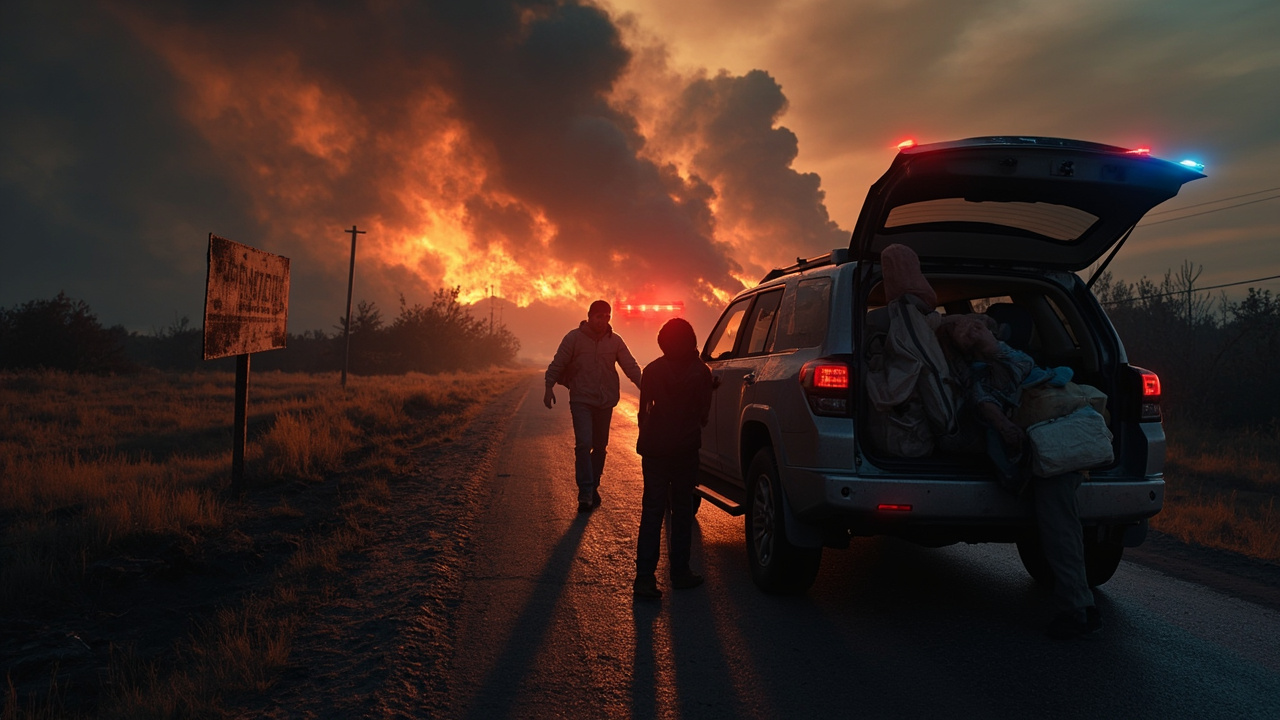
TL;DR: Households with children evacuate faster and households with older adults evacuate slower in Canada, Australia, and the United States, while most U.S. wildfire disaster losses occur in the first 24 hours after report.
New three-country study defines evacuation timing problem
A study published September 23, 2026 in Safety Science examined intended evacuation behaviors during wildfires with a focus on promptness, departure time, and cross-country differences, according to the study record titled Human behaviour in wildfire emergencies: insights from evacuation decision-making and timing across Canada, Australia, and the United States. The authors surveyed 1,366 people in Canada, 1,490 people in the United States, and 1,173 people in Australia. The team used advanced choice modelling techniques to estimate factors influencing time-related decisions. The findings emphasized the importance of preparedness, reasons for evacuating, and risk perception in shaping responses to emergencies. The authors state that insights on evacuation decisions and departure times across jurisdictional boundaries can assist in improving generalized wildfire evacuation plans and implementing more inclusive emergency communication strategies.
The author team includes Thayanne Gabryelle Medeiros Ciríaco, Mohammad Hossein Babaei, Amr M. Sakr, Marina Aziz, Erfan Hasanpour Zaryabi, Erica D. Kuligowski, and Stephen D. Wong. The listed affiliations include the University of Alberta and RMIT University. The funding acknowledgement lists the Australian Government. The study used intended behavior data rather than observed departures, which matters for preparedness planning because intentions reveal preparation gaps before smoke is visible. Transportation decisions in the study are described as quick and context-specific, and as potentially different across countries and cultures.
Why departure timing controls survival
A separate analysis posted September 19, 2026 and titled Most impacts occur on the first day of wildfires: how should we respond? identifies a subset termed short-fuse fires that become highly destructive before firefighting resources have the opportunity to succeed in containing the fire. In U.S. wildfire disasters in the past 25 years, the majority of loss in structures and lives occurred in the first 24 hours after report. The authors describe short-fuse wildfires as a hazard class defined by compressed time-to-impact. They state that recognition of that class shows key limits to conventional firefighting strategies. For households, the implication is direct: personal preparation time may be shorter than official response time.
The SSRN-listed authors are Nicholas McCarthy, Kristy Butler, Chloe Begg, Thomas Duff, Bradley M. Pietruszka, Sarah Harris, Dave Calkin, and Tom Logan. The listed affiliation for Dave Calkin is Oregon State University and for Tom Logan is University of Canterbury. The paper is listed as 17 pages. The analysis argues that future risk reduction will depend on adapting community mitigation, protection planning, firefighting strategies, and supporting policy that account for fundamental limits in wildfire response during such events. That framing places household evacuation readiness alongside agency planning rather than after it.
Common themes that compress decision time
The short-fuse analysis lists common themes of highly destructive early-loss fires, including high winds grounding aircraft, available firefighting resource supply being overwhelmed, failure of critical infrastructure, and suppression activities prioritizing life-saving interventions ahead of other values. Each theme reduces the help a household can expect in the first hours. Aircraft grounded by wind cannot slow spread toward neighborhoods. Overwhelmed supply means engines and crews cannot be everywhere at once. Infrastructure failure can disrupt power, water, communications, and road movement. A life-saving priority means firefighters may focus on rescue and evacuation support rather than structure protection.
Those constraints explain why the September 23, 2026 three-country study emphasizes promptness and departure time rather than route choice alone. Preparedness shortens the interval between warning and wheels rolling. Reasons for evacuating shape whether residents leave at the first order or wait for confirmation. Risk perception shapes whether smoke, embers, official notices, or neighbor movement triggers action. Together, those three factors determine whether a household clears the danger zone before roads degrade.
What was consistent across all three countries
Across Canada, the United States, and Australia, households with older adults were less likely to evacuate promptly, while households with children were more likely to evacuate promptly. That pattern held in all three national samples despite cultural and jurisdictional differences. The result points to mobility, assistance needs, medical equipment, and decision caution as likely sources of delay for households including older adults. It also points to heightened urgency among households with children when warnings arrive.
The study also found that complex models showed minimal or no improvement in fit relative to simpler models for estimating time-related decisions. For emergency planners, simpler models may therefore be sufficient for generalized wildfire evacuation plans. For residents, the message is that basic, observable household factors can predict delay risk without complex screening. A preparedness plan that accounts for older adults in the home addresses the most consistent delay factor identified across the three countries. A plan that pre-assigns child transport, documents, and vehicle loading addresses the urgency already present in households with children.
What differed by country
Employment, age, and income were factors relevant only in the U.S. context for evacuation preparedness time. Gender was significant exclusively in the Australian context. The study does not present those variables as universal predictors. Instead, it identifies country differences and similarities in evacuation preparedness time that require locally tuned communication.
That distinction matters for cross-border guidance. A checklist developed from U.S. data that leans on employment, age, and income patterns may not transfer directly to Canada or Australia. An Australian outreach approach that accounts for gender differences may not address the drivers most relevant in the United States. The authors specifically point to more inclusive emergency communication strategies as a use for the findings. Inclusive here means accounting for household composition and national context rather than issuing identical instructions to every community.
A real evacuation clock: Highway 831 fire
A Canadian after-action case shows how quickly those research factors become operational. An external review of the 2025 Highway 831 fire in southern Athabasca County was completed and presented at an Aug. 18 committee of the whole meeting, according to reporting titled External review identifies need for updated emergency plan in Athabasca County. The review was conducted by Tom Sampson, described as a former chair of Calgary's Emergency Management Agency and former head of the city's Emergency Medical Services. The full 43-page report was included in the Aug. 18 agenda package available on the county's website, with a breakdown of the response, statistics from workers, residents, and other impacted individuals, and eight overarching recommendations.
The report covers May 6 to May 12, 2025, when the final evacuation notice was lifted. Initial notification for the fire occurred at 3:17 p.m. on May 6, and within an hour-and-a-half the county had declared a state of local emergency. By 5:45 p.m. that afternoon, the evacuation order was in place for county residents, and at 10:49 p.m. the order was put out for village residents as well. Athabasca County Fire Chief Travis Shalapay said the evacuation to Lac La Biche went smoothly despite the late hour. He said residents did a good job of being prepared for the orders.
Communication breakdowns that add delay
The Athabasca review highlighted communication issues between the county's emergency coordination centre and the incident command post, largely due to staffing challenges. Information flow from the field to the emergency coordination centre was described as inconsistent, with critical updates difficult to obtain in a timely manner. Emergency coordination centre staff said they had to make critical decisions without full situational awareness of what was happening on scene. Operational decisions were further complicated by overlapping jurisdictions and the involvement of elected officials at both the Village of Boyle and Athabasca County, creating ambiguity regarding decision-making responsibility.
The plan at issue was signed by all three municipalities in 2023. The reviewer wrote that the plan creates a challenge in roles and responsibilities and contributes to friction among the communities. The review also described a fragmented approach to training, equipment, and the overall emergency management program. Since the plan was created, the province had updated its standards, and work had begun to bring the regional plan back in line with provincial requirements. Fire Chief Shalapay said grey areas in the plan caused municipalities to diverge when encountered.
Preparedness lessons for households with extra needs
Taken together, the three records support a practical readiness sequence. Keep documentation, medications, mobility aids, child supplies, and vehicle fuel ready before fire season because departure delays are most likely in households with older adults. Assign who assists older adults, who secures children, who loads the vehicle, and who monitors official notices because reasons for evacuating and risk perception shape promptness. Plan for a nighttime departure because the Highway 831 county order came at 5:45 p.m. and the village order followed at 10:49 p.m., with movement to Lac La Biche continuing late. Maintain an independent information source such as a battery radio because field-to-coordination information flow can be inconsistent during staffing shortages.
Volunteer capacity also shaped the Canadian response. Shalapay stressed the work of county volunteers, many of whom worked for 24 hours straight at the start of the emergency. He commended volunteers where fire threatened their own homes and noted the Village of Boyle fire department. That reliance underscores why household self-sufficiency matters in the first operational period. When local responders are extended, a household that can leave promptly reduces rescue demand and preserves crew capacity for life-saving interventions described in the short-fuse analysis.