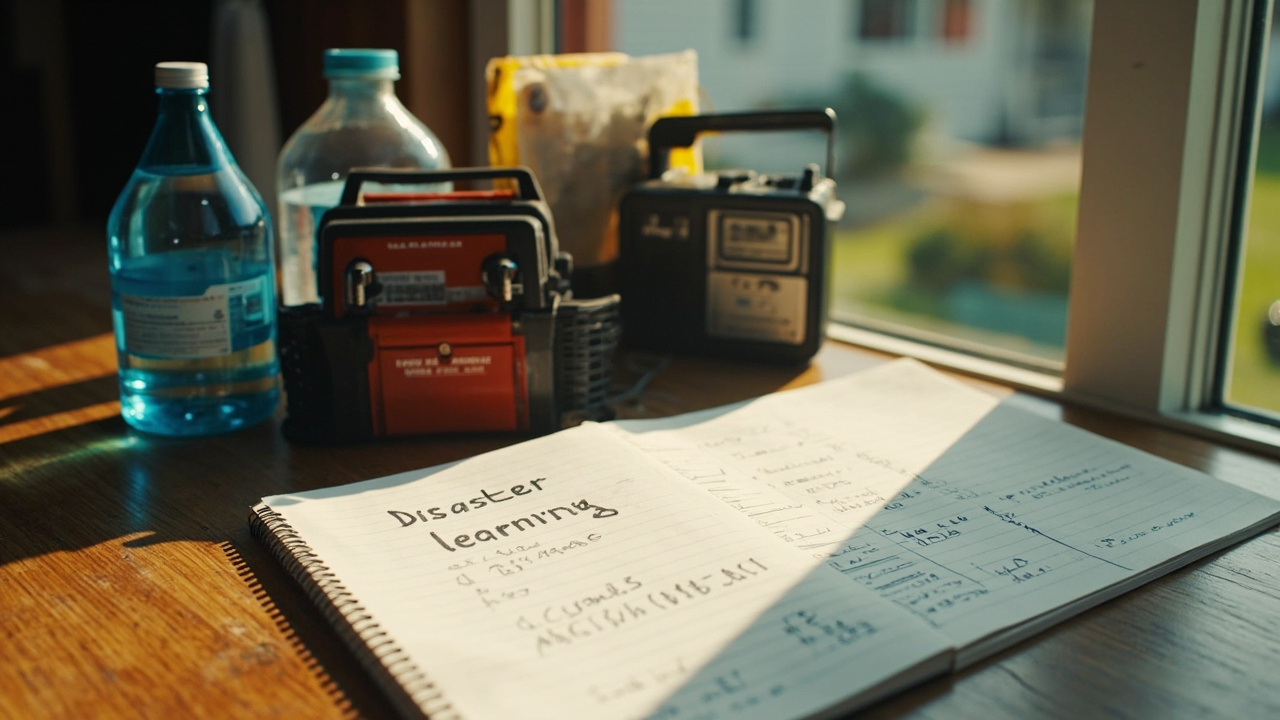
TL;DR: Living through a disaster does not by itself make a household more prepared — actively learning from disasters does, according to a 5,862-person China survey published October 12, 2026.
A direct answer for prepared households
Households that reported disaster learning showed a positive link with preparedness behavior, while past disaster experience alone showed no stable link. That is the central result from Why disaster experience does not always improve Preparedness: The role of disaster learning and heterogeneous effects, published in Safety Science on 2026-10-12.
The authors state that the frequency and severity of natural disasters and public emergencies have continued to increase worldwide. They state that household preparedness plays a vital role in disaster risk reduction, yet the effect of disaster-related experience on preparedness remains inconclusive.
For readers focused on emergency preparedness and survival, the message is practical: exposure is not capacity. What tracked with action was capacity building after exposure.
Who conducted the study and when
The paper was authored by Haocun Zhao of Hong Kong Polytechnic University and Ruyi Shi of China University of Mining and Technology, with Shi listed as corresponding author. Publication listings identify the journal as Safety Science and the publication date as 2026-10-12.
The analysis used survey data from 5,862 residents in China. That sample size makes it one of the larger recent household-level datasets to separate two ideas that preppers often combine: having been through an event, and having learned through training, information, reflection, or skill development.
A second listing of the same paper summarizes the highlights in five points: the study examines how disaster experience and disaster learning relate to household preparedness; past disaster experience shows no stable association with household preparedness behavior; disaster learning is positively associated with proactive household preparedness; causal forest analysis reveals heterogeneous effects across individual respondents; and emergency awareness, social capital, and community infrastructure shape preparedness.
How the researchers separated experience from learning
The Safety Science study separately examined the associations of past disaster experience and disaster learning with household preparedness.
It used conventional regression models and a causal forest approach to estimate average associations and explore heterogeneous effects across individuals. Conventional models were used for average associations. The causal forest approach was used to look for differences in effects across individuals.
That design matters for preparedness planning. Averages can hide the fact that the same event motivates one household while leaving another unchanged. The authors state that introducing a causal forest approach to distinguish the differential effects of past disaster experience and disaster learning provides a more nuanced understanding of household preparedness.
According to the paper listing, the work offers useful insights for developing more targeted household disaster risk reduction strategies. The emphasis is on targeted strategies, not one uniform message for every home.
Learning, not merely surviving, tracked with action
The reported result was that disaster learning, rather than past disaster experience, was positively associated with preparedness behavior. The abstract highlights the importance of capacity building alongside that result.
In other words, the households that acted were more often the households that had converted an event or warning into knowledge and skills. The experience-only group did not show the same consistent pattern.
That distinction helps explain a pattern many emergency managers describe: after floods, storms, earthquakes, or prolonged outages, some residents stock water, test radios, organize documents, and map evacuation routes, while neighbors with similar exposure do little. The China data suggest that the difference may come less from who saw damage and more from who received or pursued structured learning.
The authors do not present disaster learning as a completed intervention in this abstract. The finding is described as an association with preparedness behavior, not as proof that a named course caused a measured increase.
Effects were not the same for everyone
Both past disaster experience and disaster learning exhibited heterogeneous effects across individuals, according to the Safety Science abstract.
The companion listing phrases the same point as causal forest analysis revealing heterogeneous effects across individual respondents. For preparedness, heterogeneity means planners should expect varied responses to the same drill, handout, siren test, or community meeting.
Feature importance analysis further indicated that social capital, emergency awareness, and community infrastructure are important influential factors associated with preparedness behavior. The companion bullet list names the same three areas as shaping preparedness: emergency awareness, social capital, and community infrastructure.
Those three factors point toward a household-plus-neighborhood model. Awareness affects whether a household recognizes a threat. Social capital affects whether help, information, tools, and transportation are available. Community infrastructure affects whether warnings, shelters, water systems, roads, and clinics function when needed.
A Texas contrast: when experience did track with action
A separate case study focused on Hurricane Beryl in Texas offers a useful contrast and is catalogued as Exploring the Impact of Institutional Measures on Household Disaster Preparedness through a Recreancy Lens: A Case Study of Hurricane Beryl in Texas.
That study was authored by Afsana Kona, published by Virginia Tech, and dated 2026-10-08. It used Hurricane Beryl in 2024 in Texas as a case study and collected data from 540 respondents across 23 counties affected by the hurricane.
The Texas analysis used Stata version 18.5 and conducted descriptive analysis as well as hierarchical ordinary least squares regression models. Responses to open-ended questions were analyzed thematically to contextualize participants’ insights.
Its quantitative results suggest that higher risk perception and prior disaster experience were positively associated with preparedness behaviors. That result differs from the no-stable-association result for past experience in the China survey, which underlines the authors’ broader point that effects vary by setting and person.
The Texas study also reports that the relationship between institutional trust and perceived institutional failure is complex and does not follow a linear pattern. It states that trust can facilitate preparedness but may also reduce perceived urgency to act. It states that perceptions of institutional failure are associated with reduced reliance on formal information sources and, in some cases, lower preparedness.
Analysis of open-ended responses further highlighted challenges from inconsistent communication and dissatisfaction with prior institutional responses that adversely affected community preparedness actions. The study states that preparedness is not solely individual behavior but is deeply influenced by institutional credibility and performance.
What shapes learning inside organizations
A third study from the same news week examined crisis learning among public-sector responders. The paper Beyond Single-Cause Explanations: An Integrated Framework for Crisis Learning in Public Organisations: A Survey Experiment in China was published in the Journal of Contingencies and Crisis Management on 2026-10-08.
It involved 557 civil servants within Shandong Province’s emergency management system. The design was a between-subjects vignette experiment in which two crisis categories — industrial accidents and public health emergencies — were each varied along a 2 x 2 x 2 factorial design, yielding 16 experimental conditions in total.
Results indicated that high crisis frequency was associated with significantly stronger learning in accident-disaster scenarios, whereas the frequency estimate did not reach statistical significance in public-health scenarios. Internal causal attributions were associated with greater learning, yet the effect did not reach significance on its own. Events occurring within the respondent’s province showed a modest positive association with crisis learning.
Combination comparisons showed lower learning scores for low-frequency incidents with external causes and for low-frequency, out-of-province events. The authors point to the value of examining crisis attributes jointly and in context when studying crisis learning.
For a preparedness-minded household, the organizational lesson is indirect but relevant: frequency, cause, and proximity appear to shape whether institutions learn. Households that depend entirely on outside agencies may therefore face uneven institutional learning.
What this means for a family readiness plan
The China household study does not prescribe a named gear list. Its actionable idea is to treat every close call, outage, boil-water notice, evacuation warning, or community drill as raw material for capacity building.
That can include writing down what failed last time, testing stored water and lighting, practicing a route, meeting neighbors, and checking how warnings and shelters work locally. Those steps align with the three factors named in the feature-importance result: emergency awareness, social capital, and community infrastructure.
The Texas Beryl findings add a communications lesson: maintain more than one trusted information source, because reduced reliance on formal sources and inconsistent communication were linked with preparedness problems in that case.
The organizational-learning experiment adds a caution about distance and rarity. Low-frequency, externally caused, out-of-area events produced lower learning scores among surveyed civil servants. Households can compensate by deliberately reviewing events that officials may treat as remote.
Limits to keep in mind
The Safety Science results are associations from survey data, estimated with regression and causal forest methods. The abstract describes positive association and heterogeneous effects, not a controlled trial of a preparedness program.
The Texas Beryl results are also survey-based, from 540 respondents across 23 affected counties, with thematic analysis of open-ended answers. The China civil-servant results come from a vignette experiment with 557 participants in one provincial emergency management system.
Taken together, the three records available by October 12, 2026 support a narrow but important conclusion: disaster learning showed the clearer positive link with household preparedness in the 5,862-resident China survey, effects differed across people, and social capital, emergency awareness, and community infrastructure were important factors in that analysis.