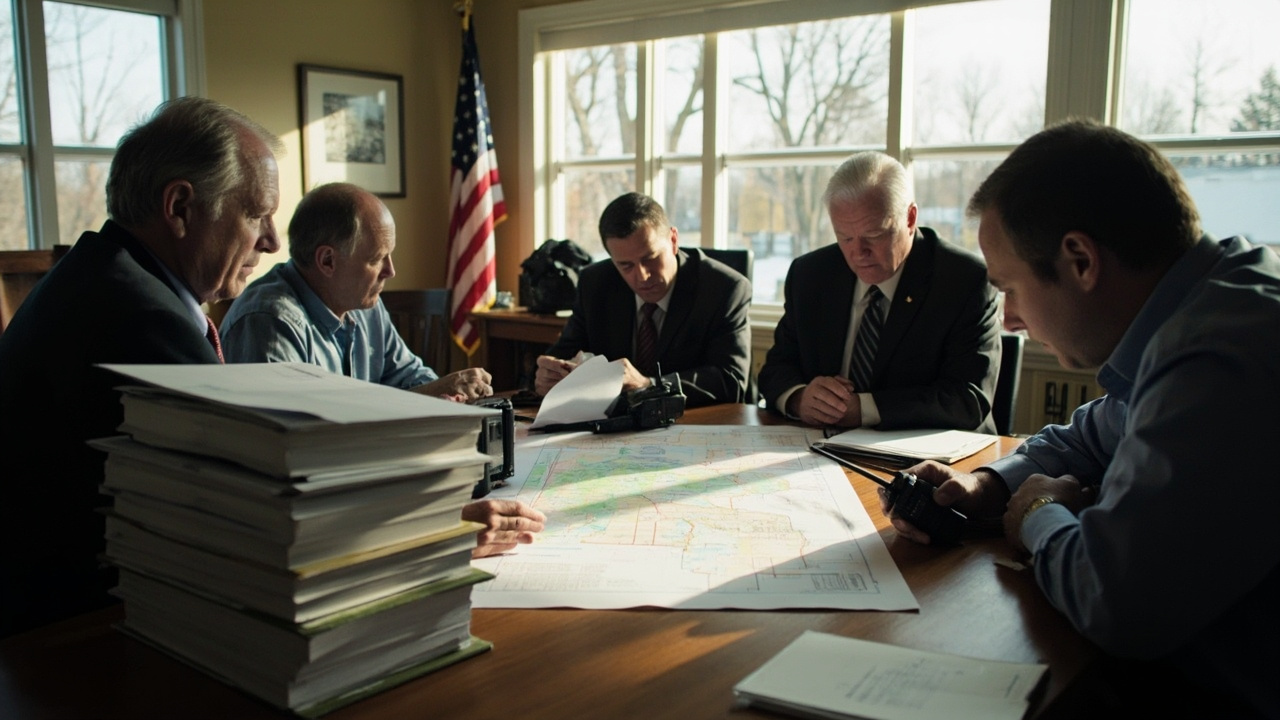
TL;DR: FEMA's April 2025 Local Elected and Appointed Officials Guide tells local senior officials to lead before, during and after disasters by working with emergency managers, issuing local declarations, supplying damage assessments for state and federal requests, and using Individual Assistance, Public Assistance and Hazard Mitigation Assistance.
What The Local Officials Guide Asks Town Leaders To Do
Local elected and appointed officials manage local resources and declare disasters when incidents overwhelm local capabilities, according to the Local Elected and Appointed Officials Guide. The document, titled Local Elected and Appointed Officials Guide: Roles and Resources in Emergency Management and dated April 2025, gives senior officials an executive-level introduction to emergency management concepts and principles.
FEMA describes the publication as a way to make it easier for senior officials to understand, prepare for and execute leadership responsibilities to help mitigate community risks, save lives, protect property and recover from disasters, according to FEMA Releases “Local Elected and Appointed Officials Guide: Roles and Resources in Emergency Management”. The same announcement states that the guide identifies local senior officials' roles and responsibilities before, during and after disasters and explains how to access additional resources.
The guide uses the term senior officials for elected and appointed leaders. It states that communities can respond more effectively during disasters when senior officials are familiar with emergency management processes and have established relationships with emergency managers.
Who Counts As Local Government
The guide defines local government for its purposes to include a county, municipality, city, town, township, local public authority, school district, special district, intrastate district, council of governments, regional or interstate government entity, or agency or instrumentality of a local government.
The definition also includes an Indian tribe or authorized tribal organization, or Alaska Native village or organization, that is not an Indian tribal government as defined in 42 U.S.C. § 5122(6), and a rural community, unincorporated town or village or other public entity. The guide cites 6 U.S. Code section 101(13) for that definition and notes that other definitions may apply in individual states, local entities, Tribal Nations or territories.
The guide explains that the reference in that statute to tribal nations as local governments must be understood in light of the Sandy Recovery Improvement Act of 2013, Pub. Law No. 113-2. It states that the Stafford Act, as amended by that law, now reflects that tribal governments are sovereign and acknowledges the direct government-to-government relationship between the United States and Tribal Nations.
How Many Counties Have Emergency Staff
A 2019 survey found 88% of responding county governments have established emergency management agencies to protect residents, as cited in the guide. More than 70% of these agencies' directors report to elected officials.
The guide states that many senior officials therefore have direct access to emergency management expertise and dedicated staff. It presents emergency management as a specialized field that builds community resilience through planning and training.
What Senior Officials Do Before A Disaster
The guide organizes senior official duties into before, during and after phases. Appendix A is titled Senior Officials Checklist and contains Before Disaster, During Disaster and After Disaster sections.
Before-disaster work centers on policy and resource decisions, collaboration with emergency managers, and understanding community needs. The guide states that senior officials may work closely with the private sector and local and state government organizations to allocate scarce resources in the aftermath of a disaster, and that collaboration with emergency managers helps officials understand community needs and make informed decisions.
Community Resource Assistance is a separate chapter with sections titled Enabling Disaster Assistance, Mutual Aid, State, Territorial and Tribal Resources, and Federal Capacity-Building Grant Opportunities. Mutual aid, state resources, territorial resources and tribal resources are listed as avenues beyond a jurisdiction's own capacity.
What Senior Officials Do During Response
The chapter Leading Communities to Address Threats and Hazards includes What Can Go Wrong, Who Steps Up When Disaster Strikes, and Leading Before, During and After Disasters. The guide states that the public often sees senior officials as responsible for the success or failure of disaster response and recovery efforts.
Key National Incident Management System concepts appear in Appendix C. Listed concepts include Incident Command System, Unified Command, Emergency Operation Centers, Multiagency Coordination Groups, and Joint Information Systems and Joint Information Centers.
The guide therefore places local leaders alongside incident command structures, emergency operations centers and coordination groups rather than apart from them. Joint Information Systems and Joint Information Centers address public information functions.
How Local, State And Federal Declarations Connect
Emergency and Disaster Declarations and Proclamations is a full chapter. It contains Local Disaster Declarations, State and Territorial Declaration Process, Tribal Declaration Process and Federal Declaration Process.
Local elected and appointed officials serve as the first line of response and collaborate with state and federal partners throughout the disaster cycle under the Stafford Act. Governors or tribal chief executives submit formal requests to the President for federal emergency or major disaster declarations, while local officials provide the damage assessments and information necessary to justify those requests.
That division matters for preparedness planning. A local declaration documents that an incident has overwhelmed local capabilities. Damage assessments and local information then support a governor or tribal chief executive request to the President.
What Federal Aid Can Follow A Presidential Declaration
FEMA assistance programs activated following a Presidential declaration include Individual Assistance, Public Assistance and Hazard Mitigation Assistance.
Individual Assistance provides support directly to individuals and households. Public Assistance offers federal grants to state, local, tribal and territorial governments, as well as certain nonprofits, for debris removal, emergency protective measures and restoration of public infrastructure. Hazard Mitigation Assistance provides funding for long-term projects to reduce risk, such as the Hazard Mitigation Grant Program and Flood Mitigation Assistance.
Appendix D, titled Federal Disaster Financial Resources, lists additional federal sources. Entries include the Federal Emergency Management Agency, Small Business Administration Disaster Assistance Loans, U.S. Department of Agriculture, Department of Housing and Urban Development, Department of Health and Human Services, Department of Transportation, Environmental Protection Agency and Bureau of Indian Affairs.
Why The Five-Year Hazard Mitigation Plan Matters
To maintain eligibility for certain FEMA grants, local governments must have an approved, adopted hazard mitigation plan, which must be updated every five years. Local officials are responsible for participating in that planning process and formally adopting the strategies in accordance with local laws.
That requirement links day-to-day governance to later funding. Participation and formal adoption under local laws preserve eligibility. An outdated or unadopted plan can limit access to funding that would otherwise support risk-reduction work.
Who Else Senior Officials Must Consider
Key Stakeholder Considerations is a chapter with sections for Individuals with Disabilities, Individuals with Access and Functional Needs, Private Sector Organizations, Voluntary and Non-Governmental Organizations, and Individual Preparedness.
Private sector organizations and voluntary and non-governmental organizations are therefore named alongside government partners. Individuals with disabilities and individuals with access and functional needs receive separate consideration in the guide structure.
The Recovery Continuum appears in Appendix B. The guide also includes a conclusion chapter and supporting sections for glossary, acronyms and links to additional informational resources.
What Training And Reference Tools Exist
Appendix E, titled Federal Training, lists Independent Study Courses described as self-paced and free of charge, and Senior Official Oriented In-Person Courses.
FEMA's planning site states that the document and associated quick reference guide and checklist provide an executive-level introduction for local senior officials and identify roles and responsibilities before, during and after disasters, according to Planning Guides. Download options identified there include the Quick Reference Guide and Checklist.
The 2022 release announcement lists three associated resources: Local Elected and Appointed Officials Guide, Local Elected and Appointed Officials Quick Reference Guide and Local Elected and Appointed Officials Checklists. It also describes a seven-minute video associated with the guide materials.
FEMA hosted a series of 60-minute webinar sessions to provide an overview of the guide and associated quick reference guide, checklists and seven-minute video. The announcement states that the sessions would include facilitated discussions with stakeholders and provide updates since the National Engagement period.
When FEMA Briefed Officials On The Guide
FEMA scheduled webinar sessions tied to the release. Listed sessions included 4:00 p.m. EDT on Wednesday, Oct. 12, 10:00 a.m. EDT on Tuesday, Oct. 18, and 3:00 p.m. EDT on Thursday, Oct. 20, in 2022. Advance registration was required and on a first-come, first-served basis.
The announcement contact for assistive accommodations was [email protected]. The National Integration Center contact listed for planning questions is [email protected].
For households, the practical point is direct. Ask whether your county, city, town or township has an emergency management agency, whether its hazard mitigation plan is current and adopted, and whether local leaders use the Senior Officials Checklist for before, during and after actions.