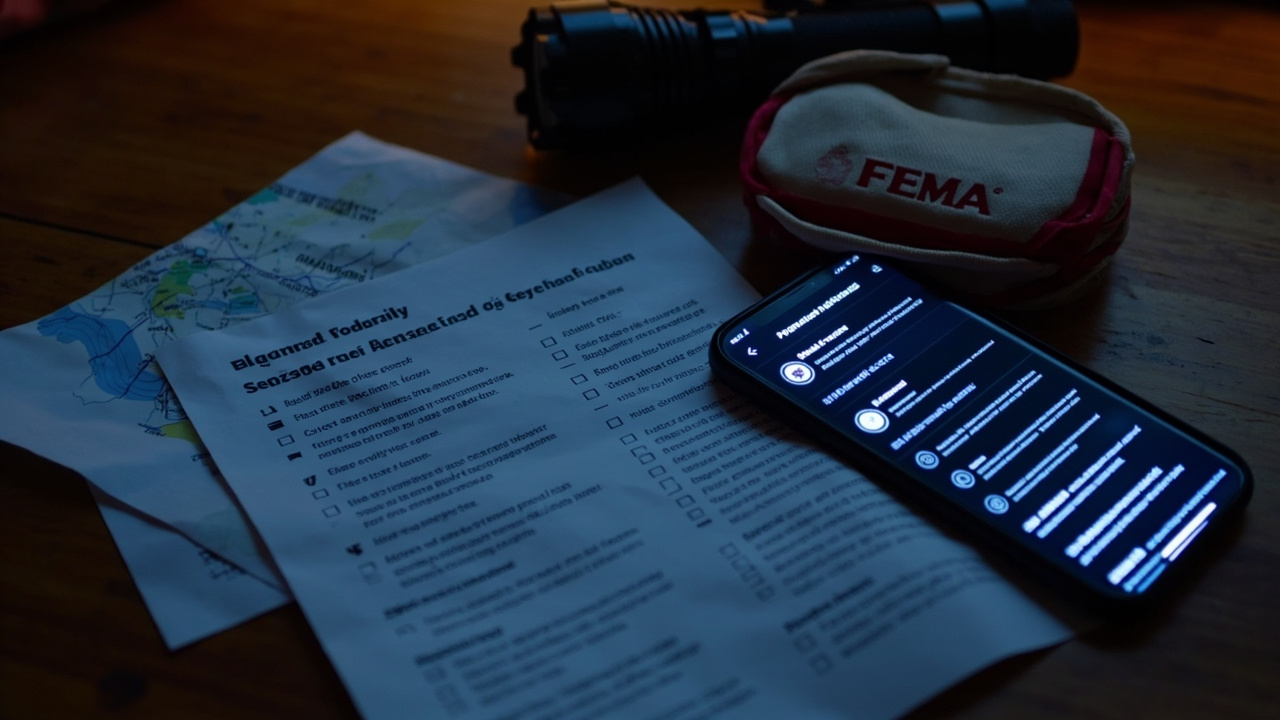
TL;DR: Build a written family disaster plan that covers alerts, shelter, evacuation routes, communication, and kits, then practice it, according to Make A Plan | Ready.gov.
Start With Local Hazards, Alerts, and Routes
Your household may not be together when an incident occurs, so identify which types of disasters could affect your area first, according to Make A Plan | Ready.gov. From that starting point, decide how members will contact one another and reconnect if separated. Establish a family meeting place that is familiar and easy to find.
Know how you will obtain emergency alerts, and know where you would go if evacuation becomes necessary, according to Disasters and Emergencies | Ready.gov. That same source advises families to maintain a plan and rehearse it often. For mobile access to preparedness strategies and real-time weather and emergency alerts, download the FEMA App.
Use two-sided Hazard Information Sheets to study how to prepare for, remain safe during, and respond to specific threats, according to Disasters and Emergencies | Ready.gov. Individual English sheets are offered for Active Shooter, Avalanche, Cyberattack, Earthquake, Extreme Heat, Financial Emergency, Flood, Hurricane, Landslide, Novel Pandemic, Power Outage, Thunderstorm, Lightning, and Hail, Tornado, Tsunami, Volcano, Wildfire, and Winter Storm. Additional-language sheets are available for Active Shooter, Avalanche, Cyberattack, Earthquake, Extreme Heat, Flood, Hurricane, Landslide, Novel Pandemic, Power Outage, Thunderstorm, Lightning, and Hail Info Sheets, Tornado, Tsunami, Volcano, Wildfire, and Winter Storm.
For broader household and neighborhood preparation, consult the Are You Ready? Guide, described by Disasters and Emergencies | Ready.gov as a comprehensive resource with detailed information on preparing within families and communities. The guide presents general disaster preparedness tips and best practices to inform planning. English and additional-language editions are listed on the same page, which was last updated 07/21/2026.
Learn the Alert and Warning System Before You Need It
When disaster strikes, know where to turn for updates, alerts, and warnings, according to Disasters and Emergencies | Ready.gov. The Know Your Alerts and Warnings publication outlines the U.S. alert and warning systems and explains the information each source can provide. English and additional-language versions are offered.
A separate Guide for Alerts and Warnings explains what to do upon receiving a hazard alert at home or in a vehicle, according to Disasters and Emergencies | Ready.gov. That guide addresses 17 hazards, their alerts, and protective actions intended to support safety. Download options are listed alongside the other hazard publications.
Make A Plan | Ready.gov, last updated 09/01/2026, also lists Know Your Alerts and Warnings among its additional resources, alongside the Family Communication Plan Fillable Card and 12 Ways to Prepare. The 12 Ways to Prepare item is described by Disasters and Emergencies | Ready.gov as a 9” x 6” cardstock postcard covering 12 key preparation actions, formatted so a USPS mailing sticker can be added for distribution to community members.
For residences and workplaces, the alert question should be answered first in writing. Make A Plan | Ready.gov frames it as: How will I receive emergency alerts and warnings?
Step 1: Hold a Household Planning Meeting
Make A Plan | Ready.gov organizes family planning into four steps, beginning with a meeting of family, friends, or household members. Use that discussion to start the written emergency plan around five questions:
- How will I receive emergency alerts and warnings?
- What is my shelter plan?
- What is my evacuation route?
- What is my family/household communication plan?
- Do I need to update my emergency preparedness kit?
Record the answers rather than leaving them verbal. The page provides a fillable Make a Family Emergency Plan form for household information, names and contacts of family members, meeting places, and medical information. Related tools include the Family Communication Plan Fillable Card, also offered in additional languages.
Practice the completed plan with the household, which is Step 4 in the same sequence, according to Make A Plan | Ready.gov. Repetition helps members remember meeting locations, contact methods, and assigned tasks.
Commuters should add travel-specific detail. Make A Plan | Ready.gov lists an Emergency Plan for Commuters PDF among its additional resources. Pet owners have a dedicated Pet Owners PDF in the same resource list.
Step 2: Tailor the Plan to Medical, Dietary, and Access Needs
Customize plans and supplies to the daily living needs and responsibilities of the household, according to Make A Plan | Ready.gov. Discuss how people in the support network can assist one another with communication, care of children, business needs, pets, or other requirements.
The same source lists factors to consider during that assessment:
- Different ages of members within the household
- Responsibilities for assisting others
- Locations visited frequently
- Dietary needs
- Medical needs including prescriptions and equipment
- Disabilities or access and functional needs including devices and equipment
- Languages spoken
- Cultural and religious considerations
- Pets or service animals
- Households with school-aged children
Include medication and document details in the written file. Make A Plan | Ready.gov points to Tips for Medications graphics, Save Important Documents to the Cloud graphics, and Low and No Cost Preparedness graphics. It also links Safeguard Critical Documents and Valuables and Document and Insure Your Property, both described further by Disasters and Emergencies | Ready.gov.
The safeguards publication includes a checklist to help prepare documents in case an insurance claim must be filed after a disaster, according to Disasters and Emergencies | Ready.gov. The property publication frames documentation and insurance coverage as preparation for disasters described as a matter of when, not if. Make A Plan | Ready.gov additionally lists the Emergency Financial First Aid Kit PDF and the Consumer Financial Protection Bureau Disaster Checklist PDF for financial readiness.
Step 3: Write Down Contacts, Meeting Places, and Health Details
Create the family emergency plan with the fillable form, then store copies where members can retrieve them, according to Make A Plan | Ready.gov. The form is designed to capture information that can help the family be prepared. Required categories named on the page include household information, names and contacts of family members, meeting places, and medical information.
Keep alert information with the same packet. Know Your Alerts and Warnings in additional languages, 12 Ways to Prepare in additional languages, Document and Insure Your Property in additional languages, and Safeguard Critical Documents and Valuables in additional languages are all listed as additional resources on Make A Plan | Ready.gov. Make a Plan Graphics are also listed for households that want visual reminders.
Review the kit question on a schedule. Make A Plan | Ready.gov phrases the prompt as whether the emergency preparedness kit needs updating. Align that review with the needs assessment above, particularly prescriptions, equipment, dietary items, documents, and supplies for children, pets, or service animals.
Business and Workplace Procedures: Protective Actions by Hazard
The actions taken in the initial minutes of an emergency are critical, according to Emergency Response Plan | Ready.gov. That source states that prompt action and warnings can save lives, minimize physical damage to structures and property, and allow for better resilience. It directs every business to develop and implement an emergency plan for protecting employees, contractors, and visitors.
Developing that plan begins with understanding what can happen, according to Emergency Response Plan | Ready.gov. The page directs planners to assess available resources for incident stabilization, considering internal resources and external resources, including public emergency services and contractors. Next, document available resources and determine whether external resources have the information needed to handle an emergency. Where information is missing, identify what is required and record it in the plan.
Prepare emergency procedures for foreseeable hazards and threats, with the most appropriate protective action defined for each hazard to support the safety of employees and others in the building, according to Emergency Response Plan | Ready.gov. Decide how building occupants will be warned to take protective action. Develop protocols and procedures to alert first responders, including public emergency services, trained employees, and management. Identify how communication with management and employees will continue during and following an emergency.
The same source lists 10 steps for developing the emergency response plan:
- Review performance objectives for the program.
- Review hazard or threat scenarios identified during the risk assessment.
- Assess availability and capabilities of resources for incident stabilization including people, systems, and equipment available within the business and from external sources.
- Talk with public emergency services, such as fire, police, and emergency medical services, to determine response time to the facility, knowledge of the facility and its hazards, and capabilities to stabilize an emergency at the facility.
- Determine whether regulations pertain to emergency planning at the facility and address applicable regulations in the plan.
- Develop protective actions for life safety, including evacuation, shelter, shelter-in-place, and lockdown.
- Develop hazard- and threat-specific emergency procedures using the Emergency Response Plan for Businesses.
- Coordinate emergency planning with public emergency services to stabilize incidents involving facility hazards.
- Train personnel so they can fulfill roles and responsibilities.
- Facilitate exercises to practice the plan.
For pre-incident planning, the page cites Fire Service Features of Buildings and Fire Protection Systems, U.S. Occupational Safety & Health Administration Publication 3256-07N, and Standard on Pre-Incident Planning, National Fire Protection Association NFPA 1620. For protective actions for life safety, it cites the Evacuation Planning Matrix from OSHA, Evacuation Plans and Procedures eTool from OSHA, and Design Guidance for Shelters and Safe Rooms. The page was last updated 03/25/2026.
Community Planning Concepts: Evacuation, Shelter, and Supply Chains
Accomplished properly, planning provides a methodical way to engage the whole community in thinking through the lifecycle of a potential crisis, determining required capabilities, and establishing a framework for roles and responsibilities, according to Planning Guides | FEMA.gov. The same source states that a shared planning community increases the likelihood of integration and synchronization, makes planning cycles more efficient and effective, and makes plan maintenance easier. Questions may be directed to the National Integration Center at [email protected].
For evacuation and shelter-in-place decisions, the FEMA planning collection identifies concepts, considerations, and principles that can inform jurisdictions planning those protective actions, according to Planning Guides | FEMA.gov. Supporting material includes the research report Improving Public Messaging for Evacuation and Shelter-in-Place with a companion slide library documenting findings from peer-reviewed research and recommendations for informing community members about risk and providing effective warnings.
The Shelter-in-Place Pictogram Guidance gives clear protective-action guidance for 10 hazards and three building types, including recommended interior locations by hazard, additional protective actions, and duration, according to Planning Guides | FEMA.gov. Social-media-friendly versions are available to provide clear protective-action guidance regardless of platform.
Emergency managers seeking to stabilize goods movement can use the Supply Chain Resilience Guide, which provides recommendations and best practices on analyzing local supply chains and working with the private sector to enhance resilience using a five-phased approach, according to Planning Guides | FEMA.gov. The broader FEMA collection also includes CPG 101: Developing and Maintaining Emergency Operations Plans, described as guidelines for developing emergency operations plans that promote a common understanding of community-based, risk-informed planning and decision making. Households can mirror that logic at a smaller scale: examine threats or hazards, assign roles, coordinate with neighbors, and keep the written plan synchronized with contacts, routes, and supplies.