TL;DR: A governor's pre-storm emergency order unlocks troops, road control, medical aid and a path to federal funds before a hurricane, flood or snowstorm arrives, a process explained by The Associated Press on Oct. 7, 2026 and illustrated in California on Oct. 6, 2026.
What a pre-disaster emergency order actually does
Government leaders in the United States may act ahead of destructive weather, rather than waiting until neighborhoods are flooded or snowbound. According to The Associated Press, that early tool is a state of emergency, described as a fast-track method for releasing aid in support of public safety during an expected natural disaster.
The Associated Press reported the explainer on Oct. 7, 2026, at 11:50 a.m., under the headline about a governor's order freeing National Guard and medical assistance. The piece framed hurricanes, floods and snowstorms as the kind of large weather threats that can trigger action before impact.
For households focused on emergency preparedness and survival, the distinction matters. A declaration does not mean damage has already occurred. It means executive authority has been invoked to position people, authority and money so that searches, rescues, closures and care can move faster once conditions deteriorate.
How a governor starts the process
Inside a state, the customary move is an executive order signed by the governor. According to The Associated Press, that written directive identifies the zone forecast to face the coming severe weather.
That geographic naming step is central for preppers watching county lists. The order does not declare everywhere at risk. It defines the anticipated impact area, which then guides where planners concentrate attention.
Once signed, the directive tells emergency management bodies to prepare response schemes and assign duties. According to The Associated Press, agencies receive permission to develop disaster response plans and divide responsibilities among participants.
In practical terms, that is the moment when state-level coordination begins. Local governments are not left to improvise alone, because the state structure is told to organize, allocate tasks and prepare to assist.
Which state resources can move early
A pre-event declaration opens several operational doors at once. According to The Associated Press, the National Guard may be tasked with searches, rescues and general security work.
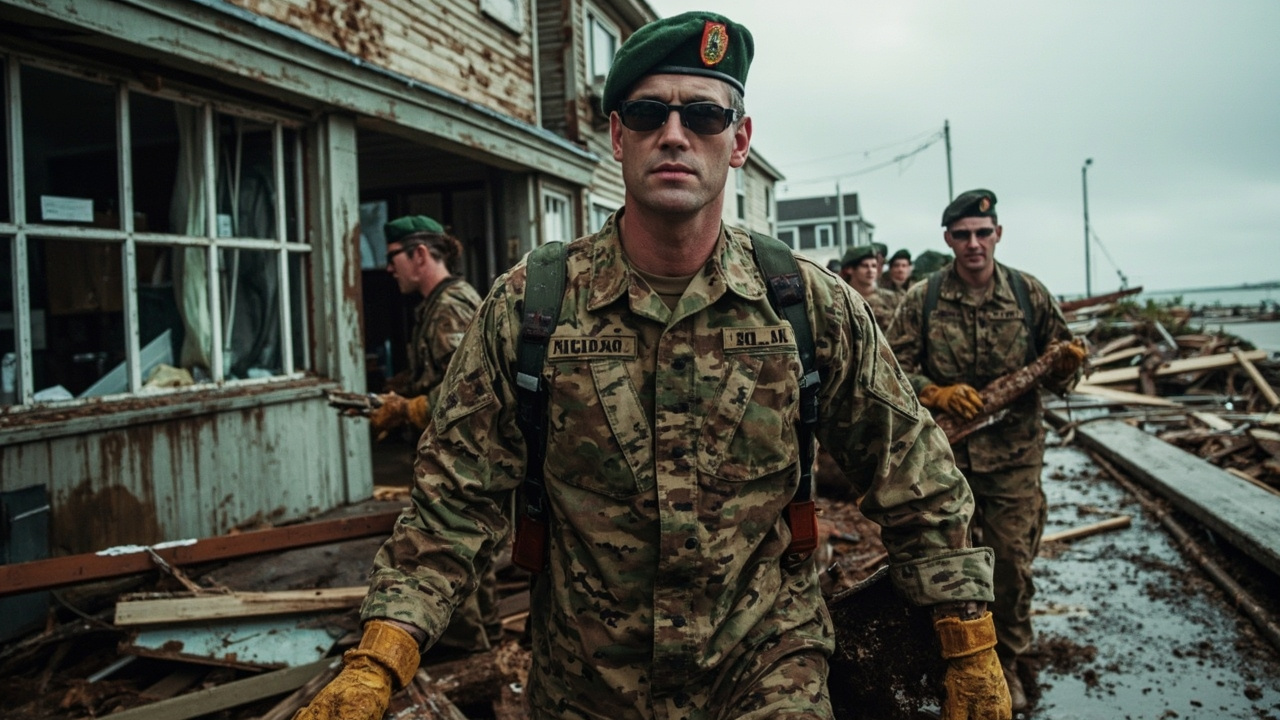
That Guard role was shown in Horseshoe Beach, Florida, on Aug. 31, 2023, one day after Hurricane Idalia passed. Members of the National Guard helped the storm-damaged business The Marina by moving and stacking debris, in an image credited to AP Photo / Rebecca Blackwell and carried with the Oct. 7 report.
A second resource involves roadways. According to The Associated Press, the highway patrol may be assigned to enforce shutdowns of roads. For families planning evacuation routes or supply runs, that signals that closures can be staffed and enforced before water rises or snow accumulates.
A third resource involves health. According to The Associated Press, the health department may be directed to deliver emergency medical services. That places doctors, nurses, ambulances and support staff inside the mobilization picture alongside uniformed responders.
How the order changes government authority
Beyond assigning agencies, the declaration alters legal relationships between levels of government. According to The Associated Press, state agencies gain authority to give direct help to local governments.
That direct-assistance power reduces delay when a town or county is overwhelmed. Instead of requesting help through slower routine channels, local officials can receive state personnel and capabilities under emergency authority.
The order also pauses conflicting administrative requirements. According to The Associated Press, it suspends state rules and regulations that might obstruct emergency plans.
For preparedness readers, that suspension is not abstract. It means procurement, travel, staffing and operational regulations that would normally slow deployment can be set aside when they stand in the way of protecting the public.
Another provision looks across state lines. According to The Associated Press, a state may enter pacts with other states to request assistance. That interstate cooperation lets a threatened state line up outside manpower and equipment before landfall or onset.
Why the state order unlocks federal dollars
A governor's action is also the gateway to Washington. According to The Associated Press, the state declaration is a required initial stage for a state seeking monetary help from the federal government through the Federal Emergency Management Agency.
The sequence then moves to the White House. According to The Associated Press, the president of the United States may issue a disaster declaration following a governor's appeal and FEMA damage evaluations.
That two-step structure explains why governors often act early even when forecasts remain uncertain. Without the state-level request and assessment record, the federal aid channel through FEMA does not open.
California's Oct. 6 example of preparation in motion
A concrete illustration of early action came from California one day earlier. According to the Office of Governor Gavin Newsom, the governor on Oct. 6, 2026, announced a new disaster-intelligence satellite capability and opened a modernized State Operations Center in Mather, California.
The announcement, published by the Governor of California and titled "Governor Newsom announces new disaster intelligence satellites, opens modernized State Operations Center as Trump erodes national disaster readiness," linked the upgrades to El Niño readiness and protection for communities, businesses and the world's fourth-largest economy.
The site is operated through the California Governor's Office of Emergency Services, known as Cal OES. According to the governor's office, the Mather facility strengthens the capacity to coordinate resources, aid local communities and defend Californians during increasingly complex disasters, including what was described as potentially the strongest El Niño season on record.
During the unveiling, Newsom received a briefing on early and proactive Niño preparations from Cal OES Director Caroline Thomas Jacobs and state emergency management leaders in Mather. The meeting focused on work underway after a September emergency proclamation in which the governor directed Cal OES to coordinate readiness for severe weather, flooding, coastal flooding, erosion, mud and debris flows, atmospheric rivers and related impacts.
What California's command hub coordinates
According to the Governor of California, the State Operations Center serves as the state's central public-safety coordinating hub. It is staffed by Cal OES and partners from across state government.
Its assigned duties include guiding the state's strategic response, maintaining statewide situational awareness and supporting continuity of government during emergencies. From Mather, leaders maintain a shared operational picture, organize mutual aid, monitor local needs and direct personnel and equipment toward where they can provide the greatest benefit.
The rebuilt center replaces an older site that had not seen a major renovation since opening in 2000. According to the governor's office, the project raised operational seating from 54 to 64 positions, enlarged second-floor workspace, created an ADA-accessible flat-floor operations area, upgraded the State Warning Center and replaced the aging technology wall.
Staffing was expanded alongside the building. According to the governor's office, the governor and Legislature approved 73 permanent posts to create a dedicated Incident Support Team and a deployable Incident Management Assistance Team. That standing workforce lessens dependence on workers temporarily pulled from other assignments and provides trained teams ready to run the State Operations Center and regional emergency operations centers during all-hazard incidents.
Cal OES Director Caroline Thomas Jacobs said coordination depends on speed and shared awareness. "During an emergency, information has to move quickly and the people making decisions need a shared understanding of what is happening across the state," Jacobs said, adding that the redesign gathers teams in quarters built for emergency work, improving coordination, situational awareness and movement of resources and support to communities faster, according to the Governor of California.
How satellites add eyes before and during storms
The second California upgrade involves orbit-based observation. Through an agreement with ICEYE, described as a satellite-imaging firm that assists governments in evaluating disaster damage from space, Cal OES is expanding access to near-real-time data on floods, wildfires and other disasters, even through clouds, smoke or darkness, according to the Governor of California.
Emergency managers can use the feed to locate active flooding, estimate water depth and evaluate possible harm to homes, roads and critical infrastructure, including during heavy cloud cover or severe weather. The information will flow into statewide emergency operations and be shared with state agencies and local emergency managers to support a common operating picture during major storms.
According to the governor's office, those capabilities can help officials identify affected communities more rapidly, prioritize response resources and begin assessment work sooner. For preparedness-minded residents, the lesson is that official evacuation, closure and rescue choices will increasingly rest on overhead flood mapping rather than ground reports alone.
What to watch when your state acts
When a governor names your county in an executive order for pending severe weather, expect emergency management agencies to begin organizing plans and delegating work. Watch for National Guard movement tied to search, rescue and security, highway patrol staffing of road closures, and health department deployment of emergency medical services, all functions identified by The Associated Press.
Also watch for state-to-local assistance, suspension of interfering state rules, and interstate aid agreements, plus the governor's request to the president for a disaster declaration based on FEMA damage assessments after the state step is complete. In California's model, also watch for Cal OES coordination from Mather, State Warning Center messaging, mutual-aid shifts, and satellite-derived flood intelligence shared with local managers, according to the Governor of California.
Sources referenced
- Before a natural disaster, a governor’s order can free up the National Guard and medical help - ABC News (https://abcnews.com/US/wireStory/natural-disaster-governors-order-free-national-guard-medical-137067907)
- Governor Newsom announces new disaster intelligence satellites, opens modernized State Operations Center as Trump erodes national disaster readiness | Governor of California (https://www.gov.ca.gov/2026/10/06/governor-newsom-announces-new-disaster-intelligence-satellites-opens-modernized-state-operations-center-as-trump-erodes-national-disaster-readiness/)