TL;DR: A Rice University report published August 28, 2026 gives Houston-area households fresh county-level benchmarks for preparedness as hurricane season continues.
Household readiness in Harris, Fort Bend and Montgomery counties is now measurable in a new way. According to Planning for the Next Disaster: Household Preparedness in the Houston Area, researchers assessed residents in spring 2026 using measures from the Federal Emergency Management Agency National Household Survey. As described in the Rice Research Repository, the snapshot measures indicators in Fort Bend and Montgomery counties for the first time and provides additional estimates for Harris County.
The same repository summary states that the snapshot describes how residents prepare across income categories and neighborhoods in the three-county region. It also states that local leaders and organizations can use results to guide investments in resident and household preparedness. The authors are listed as Anna DeLisi, Kishan Bhakta, Tingshu Liu, Aaron Niznik, D.J. Park, Daniel Potter and Dylan Simburger, with affiliation to the Kinder Institute for Urban Research.
Why this week matters for Houston households
The report arrived during active hurricane-season messaging. According to All Previous Alerts from Ready Harris, the Harris County Office of Homeland Security & Emergency Management on August 27, 2026 said it was monitoring Tropical Storm Dolly, which formed that morning in the Atlantic.
According to the National Hurricane Center, as cited in that alert, Dolly was expected to continue moving west toward the Leeward Islands. At that time, the alert stated Dolly posed no threat to Texas. The office still used the moment to urge residents to prepare now and to help friends and neighbors prepare.
That timing overlaps with National Preparedness Month planning. According to National Preparedness Month: Get Ready for Emergencies with These Easy, Budget-Friendly Steps, published August 24, 2026 by the American Red Cross, September is National Preparedness Month, described as a time to get households ready. The organization said the best protection is to be prepared before an emergency happens.
Start with a written household plan
A written plan costs nothing and anchors every other step. According to the Red Cross budget-preparedness guidance, households should pick two meeting places: right outside the home and another outside the neighborhood.
The same guidance says to think through evacuation in practical terms, including where to go and how to get there. It also says to include pets in the plan, to make emergency contact cards for the whole family for use if the internet is down, and to save that information on phones.
A Texas Gulf Coast version of that advice adds local detail. According to How to get ready for emergencies the low-cost, no-cost way, published August 27, 2026 in Woodlands Online, households should plan where they will stay and what they will take, and should plan well in advance if they will need help leaving or use public transportation.
That Woodlands Online report also says to keep a phone list of pet-friendly hotels and motels and animal shelters, to customize supplies for young children with formula and diapers, and to include leashes, carriers, food, bowls and litter for pets. It says to include the number for a child's school or daycare on emergency cards.
Build two kits: go-kit and stay-at-home kit
Red Cross guidance distinguishes between what to carry and what to keep. According to the August 24 Red Cross report, households should build both a go-kit and a stay-at-home kit. It suggests building slowly, watching for sales, buy-one-get-one offers, clearance bins, coupons and discount stores, and checking for tax-free days for emergency supplies where available.
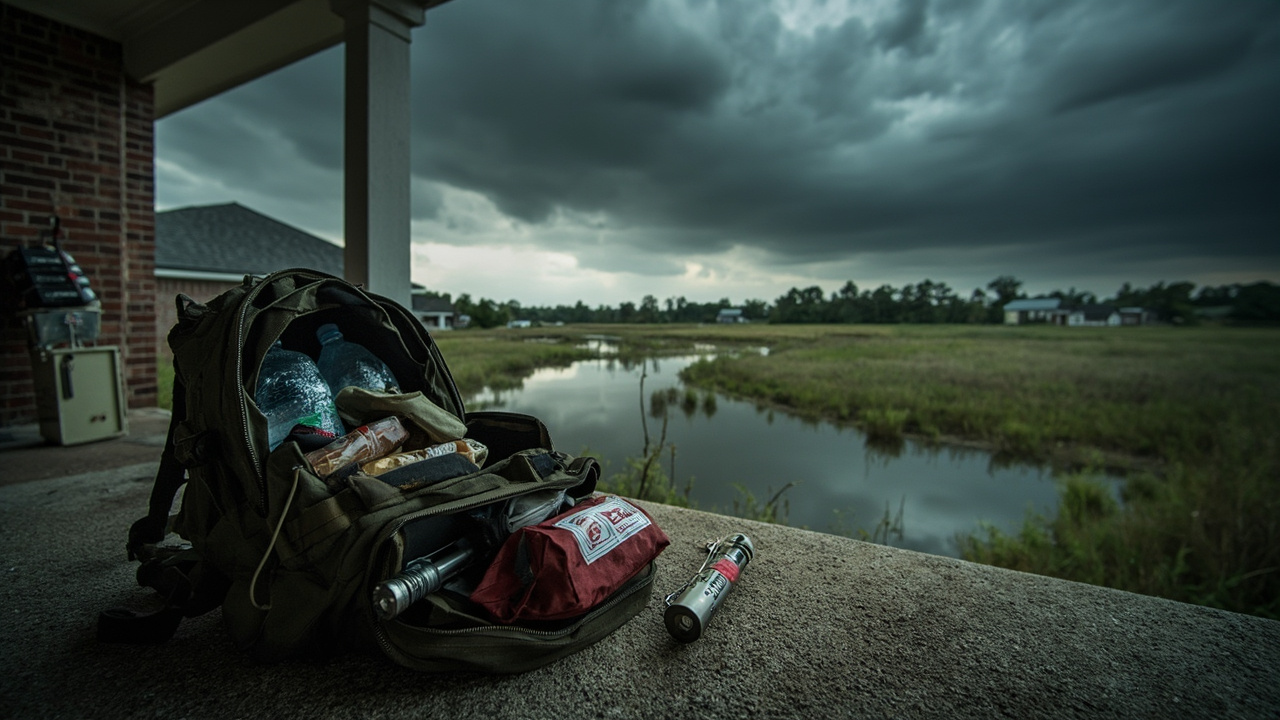
For quantities, county and nonprofit guidance differs slightly, so households should follow the higher local benchmark when in doubt. According to All Previous Alerts, Harris County emergency supply kits should contain enough non-perishable food and water to last seven days. Other listed items include medications, a first aid kit, flashlights, items for babies, and pet supplies including food, water, leashes, medications and vaccination records.
According to How to get ready for emergencies the low-cost, no-cost way, a go-kit should include three days of supplies that can be taken along, while a stay-at-home kit should have two weeks of food and water and a one-month supply of medications, if possible. Listed additions include a flashlight, first aid kit, and battery or hand-crank radio.
Power, documents and small tools
Extended outages make power and paperwork part of readiness. According to the Woodlands Online report, households should include backup batteries and chargers for devices such as flashlights, cell phones, CPAP machines and wheelchairs, plus critical personal records.
The same report lists sanitation and personal hygiene items, extra cash, area maps, matches, N95 masks, a manual can opener, extra car and house keys, towels, work gloves, a multi-purpose tool, blankets and sleeping bags. It also says to use items already on hand to keep costs down and to add one item at a time when shopping.
Local utility-district guidance adds a fuel and charge check. According to Hurricane Preparedness for Harris County, published August 24, 2026 by Harris County MUD 449, households should fuel vehicles and charge electronic devices before a storm. That guide defines hurricane season as June 1 through November 30 and says preparing before arrival can help keep families safe and reduce home damage.
Know your evacuation zone and assistance options
Evacuation readiness is address-specific. According to All Previous Alerts, residents who live in an evacuation zone need to know evacuation routes and follow instructions from local authorities. To check a home location, the alert points to the Zip Zone Evacuation Map.
Residents who may need evacuation help have a separate registry. According to the same alert, individuals can sign up with the State of Texas Emergency Assistance Registry, known as STEAR, online or by calling 2-1-1. The alert describes it as a free service for individuals who are medically fragile, have access or functional needs, and who may require transportation assistance during an emergency.
The full Emergency Essentials Checklist is listed as available at www.readyharris.org under Get Prepared, according to the same county alert. The county also points residents to a hurricane preparedness and evacuation guide for more information.
Flood insurance, even without prior flooding
Insurance is presented as preparedness, not only recovery. According to All Previous Alerts, homeowners, renters and business owners are encouraged to get flood insurance even if they have never experienced flooding. Residents who already have coverage are urged to check that the policy is still active.
Municipal utility guidance repeats that point. According to Hurricane Preparedness for Harris County, households should secure outdoor items and review flood insurance coverage before a storm. That short checklist also calls for making a family emergency plan and building a kit with at least 3 to 7 days of food, water, medications and other essentials.
Those steps sit against a changed flood-control landscape. According to Nine years after Harvey: Is Houston safer from flooding?, published August 25, 2026 by Click2Houston, Harris County has more flood-control infrastructure than nine years ago, but experts say no realistic amount of infrastructure can fully protect the region from rainfall on Harvey's scale.
What changed since Harvey
Harvey remains the reference storm. According to the Click2Houston report, Harvey made landfall near Rockport as a Category 4 hurricane on August 25, 2017, then stalled and produced days of catastrophic rainfall across Southeast Texas. The National Weather Service is cited as saying Houston-area totals ranged from 4.62 inches to 56 inches.
One year later, Harris County voters approved a $2.5 billion bond for flood-risk reduction, according to the same report. That funding, combined with local, state and federal partnership funds, supports work across county watersheds.
In a September 2025 update cited in the report, the Harris County Flood Control District said $1.5 billion had been invested through the bond program. The district said that work had created 16,000 acre-feet of stormwater detention, improved 46,000 linear feet of channels, preserved 5,800 acres and moved more than 3,100 families out of vulnerable areas through voluntary buyouts.
The same report said the district reported 54 completed bond initiatives and 75 active initiatives funding more than 240 individual projects. A newer county budget document cited in the report says that by June 2026, 58 bond initiatives had been completed and 72 remained active, with another 25 paused, 15 closing and 11 transferred.
Infrastructure helps locally, not everywhere
Detention basins reduce risk in specific drainage areas, not across the whole region. According to the Click2Houston report, the Inwood Forest Stormwater Detention Basin in the White Oak Bayou watershed was designed to hold stormwater during heavy rain and release it gradually, reducing water moving downstream at one time.
Michael Willis, described as a lifelong Houston resident living near the basin, said his home did not flood during Harvey and that water reached the sidewalk, according to the same report. The report quotes his caution about what happens once the basin fills and his hope that it works as intended.
Rice University assistant professor of civil and environmental engineering James Doss-Gollin is quoted as answering “about the same” when asked whether Houston is safer overall. According to the same report, he said new infrastructure has reduced flood peaks in some places, while regional growth has added homes and pavement in areas that once absorbed water.
Stay informed before, during and after
Alerts are part of the kit. According to All Previous Alerts, residents can sign up for weather and emergency alerts at www.readyharris.org and can text GULF2026 to 888777 for hurricane-season updates. The county also lists Ready Harris Alerts and Ready Harris Accessible Alerts, its website and social media channels.
According to the August 24 Red Cross report, households should learn how local officials share critical information such as evacuation notices, and should learn what emergencies may occur locally, from home fires and medical emergencies to community-wide floods or earthquakes. The report also urges downloading the Red Cross Emergency app, which it describes as free, available in English and Spanish, designed with accessibility in mind, and including preparation guides, National Weather Service alerts, live weather maps and help locating shelters.
During and after a storm, the municipal checklist is direct. According to Hurricane Preparedness for Harris County, residents should stay indoors and monitor official weather updates, never drive through flooded roadways, and use generators outdoors only and away from windows and doors. Afterward, it says to avoid downed power lines and floodwaters, report utility outages to the provider, and follow local guidance on road closures, debris collection and any boil-water notices.