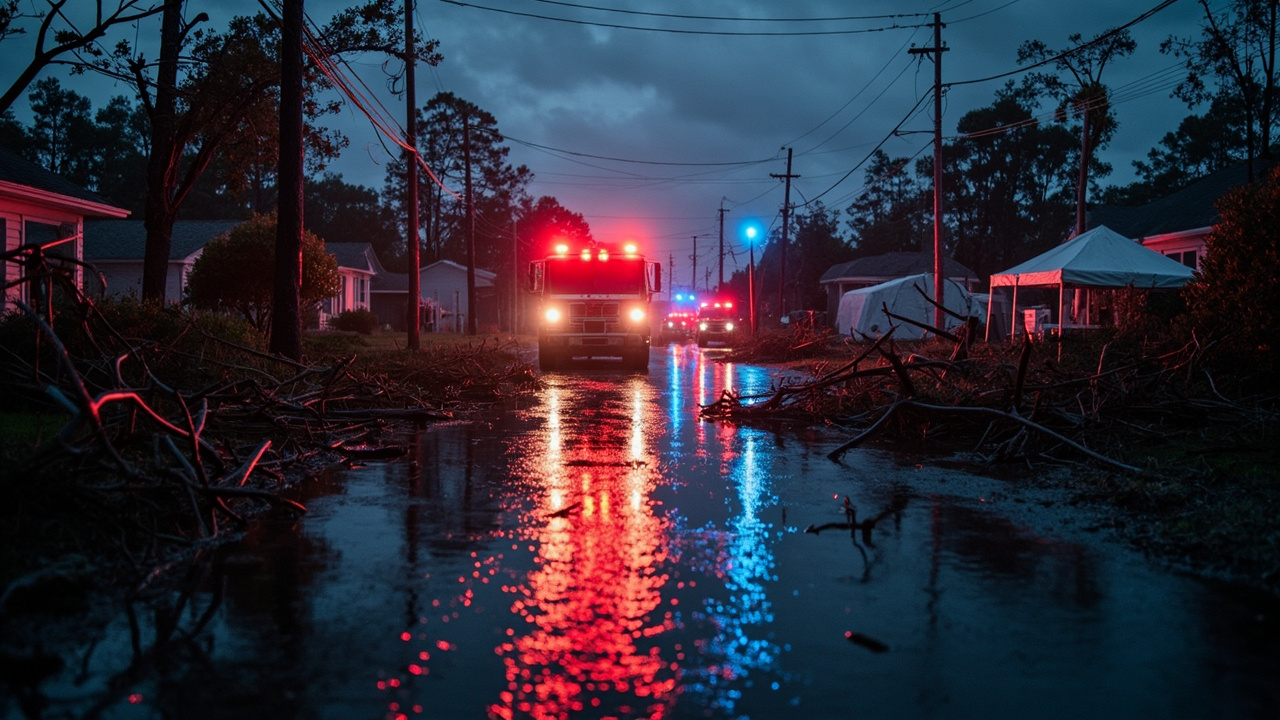
TL;DR: Hurricane Isaias made landfall as a Category 2 in the Florida Panhandle on the night of October 9, 2026, triggering federal emergency declarations in parts of Florida, Alabama and Georgia but no major-disaster household aid as of October 13, 2026.
Hurricane Isaias was the first hurricane of the 2026 Atlantic season to make landfall in the conterminous United States, according to the October 13, 2026 Congressional Research Service Insight republished as Hurricane Isaias: Brief Overview of FEMA Programs, Resources, and Selected Issues - EveryCRSReport.com. That briefing records landfall in the Florida Panhandle as a Category 2 hurricane on the night of Friday, October 9, 2026. The same briefing states that the storm brought high wind, significant rainfall, flooding, and power outages to many areas across the Southeast.
For preparedness readers, the timing and geography matter. A late-season Category 2 landfall on the Gulf Coast created simultaneous wind, rain, flood and outage hazards across more than one state. The federal record on October 13 described the situation as still dynamic, with damage assessment continuing. Florida in particular was still assessing hurricane-related damage when the Insight was issued.
Emergency declarations issued October 9
On October 9, President Trump issued several emergency declarations for certain counties in Florida, Alabama and Georgia, according to Hurricane Isaias: Brief Overview of FEMA Programs, Resources, and Selected Issues - EveryCRSReport.com. Those declarations authorized federal assistance to save lives, to protect property, and to take other measures that may prevent the incident from becoming a major disaster.
The briefing lists the kinds of measures covered under that emergency footing. Such measures include evacuations, emergency food and shelter, and the pre-positioning of rescue equipment. In other words, the October 9 actions were directed at the immediate life-safety and incident-stabilization phase.
Coverage was not statewide. The Insight describes the declarations as applying to certain counties, with the possibility of amendments to add counties. It states that additional declaration requests or amendments to existing requests may be forthcoming. That caution reflected ongoing state damage assessments.
A second account, the October 12, 2026 Morning Overview report titled FEMA approved emergency declarations for Isaias covering 27 Florida areas and parts of Alabama and Georgia, provides the declaration numbers and area counts from FEMA records. It lists EM-3655 for Florida with 27 designated areas, EM-3656 for Alabama with four areas, and EM-3657 for Georgia with nine areas. The total across the three emergency declarations was 40 designated areas.
Why an emergency declaration is not a major disaster
The distinction between an emergency and a major disaster controls what FEMA can do next. Presidential declarations of emergency or major disaster made pursuant to the Robert T. Stafford Disaster Relief and Emergency Assistance Act may authorize FEMA assistance, according to Hurricane Isaias: Brief Overview of FEMA Programs, Resources, and Selected Issues - EveryCRSReport.com.
The Stafford Act is identified in that briefing as P.L. 93-288, as amended, at 42 U.S.C. §§5121 et seq. Emergency declarations under that authority may authorize more limited forms of assistance than major disaster declarations. That single sentence is central for households planning around Isaias.
The authorized forms of assistance may vary by designated area, per the declaration, subject to amendment. The President can also amend emergency and major disaster declarations to reduce the affected state's cost-share requirements for Public Assistance. Information about state and county assistance authorizations is published in FEMA's declaration database, with additional releases potentially posted to the FEMA Blog, according to the same Insight.
For Isaias, all three October 9 records were emergency declarations rather than major disaster declarations. The Morning Overview analysis of the FEMA data notes that nothing in those records opened household-level grant programs. Residents checking eligibility therefore needed to look for a specific county or tribal nation name, not assume coverage from a neighboring county.
Three FEMA programs that could follow
The Congressional Research Service Insight outlines three programs that presidential Stafford Act declarations may authorize. Understanding each program helps families separate immediate response support from later rebuilding support.
Public Assistance, known as PA, provides grants and direct assistance to state, tribal, territorial and local governments, and certain private nonprofit organizations. The briefing states that PA covers emergency work, defined as debris removal and emergency protective measures, and permanent work, defined as rebuilding and replacement of disaster-damaged facilities. PA therefore flows to public-sector and qualifying nonprofit applicants, not directly to homeowners.
Individual Assistance, known as IA, supports disaster survivors. The Insight lists its components as grants of financial and direct assistance for housing and other needs, plus crisis counseling, case management services, legal services and disaster unemployment assistance. IA is the program most closely associated with household recovery, but it requires the appropriate declaration and designation.
The Hazard Mitigation Grant Program, known as HMGP, funds mitigation and resiliency projects and programs, typically across the entire state or territory. That scope means mitigation funding is generally broader geographically than the emergency-work footprint.
The Insight stresses that emergency declarations may authorize more limited assistance than major declarations. For preparedness planning, that means food, shelter, evacuation and staged rescue resources can move under an emergency, while housing grants and large-scale rebuilding grants depend on later decisions.
Tribal and inland designations show the footprint
The area-level data illustrate how FEMA records a multi-state storm. Florida carried the largest share under EM-3655, with 27 areas including Panhandle counties such as Escambia, Leon and Wakulla, according to the Morning Overview review of FEMA records.
Alabama's EM-3656 covered four areas, including the Poarch Band of Creek Indians and Baldwin County. Georgia's EM-3657 covered nine areas, including Decatur County in the southwest near the Florida line and Paulding and Carroll counties in the northwest. The spread from coastal Panhandle counties to inland northwest Georgia shows emergency preparation extending well beyond the landfall point.
The tribal listing carries practical significance. Federally recognized tribes can appear as their own designated areas rather than being folded into surrounding counties. In the Alabama record, the Poarch Band of Creek Indians is named alongside county-level areas under the same emergency declaration.
Because FEMA names each area individually, a county or tribal nation outside the lists is not covered even if it borders a listed area. The Morning Overview report emphasizes checking the specific area name in the state's entry. Local emergency management offices and state emergency management agencies in Florida, Alabama and Georgia are the coordinating points for what resources are moving once a declaration is in place.
Wind versus water: insurance runs on separate tracks
Insurance after Isaias did not depend on a Stafford Act declaration. A Stafford Act declaration is not required for policyholders to make insurance claims, according to Hurricane Isaias: Brief Overview of FEMA Programs, Resources, and Selected Issues - EveryCRSReport.com. Hurricane damage can be caused by wind, water, or both, but those hazards are insured separately.
Wind is generally included as a covered peril in standard homeowners insurance policies. Homeowners policies are sold by private insurance companies, which are regulated at the state level. Because hurricanes can cause significant damage, many states require a separate deductible for hurricane damage. Depending on the state, insurance companies determine to some degree the level of that hurricane deductible and when it should apply.
Florida follows a statutory approach. The Florida hurricane deductible is set by statute, and all insurance companies in Florida are generally required to offer hurricane deductible options, according to the same Insight. Households in the Panhandle landfall zone therefore faced a state-specific deductible structure rather than a single national rule.
Flood follows a different path. Homeowners insurance does not cover flood damage. Homeowners must purchase separate coverage for flood losses. The National Flood Insurance Program, or NFIP, is the primary source of flood insurance coverage for residential properties. The NFIP is operated by FEMA.
The Insight states that the NFIP was currently authorized until December 11, 2026. Homeowners and tenants with NFIP flood insurance can make flood damage claims using the normal NFIP claims process. FEMA may institute a claims process specific to Hurricane Isaias at a later date, but no such storm-specific process had been established in the October 13 briefing.
How the federal response was funded
FEMA's Disaster Relief Fund, or DRF, is the primary funding source for federal government response and recovery activities. Its level of unobligated funds is often used as a proxy for overall federal resources available for response and recovery, according to Hurricane Isaias: Brief Overview of FEMA Programs, Resources, and Selected Issues - EveryCRSReport.com.
As of the end of FY2026, roughly $8.3 billion was available in the DRF to pay costs associated with major disaster declarations. Under the continuing resolution identified as P.L. 119-103, Division A, which provided interim funding for federal operations during the first months of FY2027, an additional $26.4 billion was also available. That additional amount was available until the continuing resolution expires or is replaced by an enacted annual appropriations measure covering FEMA.
Those two figures defined the funding backdrop as Isaias response began. The base DRF balance addressed major-disaster costs, while the interim appropriations measure supplied added capacity during the early part of the new fiscal year. For households, the practical meaning was that front-end emergency measures had a funded federal account behind them while damage assessments continued.
Capacity questions facing Congress and states
The Insight places Isaias in the context of the nation's bottom-up approach to emergency management. The United States takes a bottom-up approach, and when a state's capacity to manage incident response has been exceeded, it may request assistance from the federal government. Some Members of Congress may be concerned about both state and federal capacity for emergency management.
On federal capacity, the briefing identifies several potential congressional concerns. One is whether FEMA is sufficiently staffed, noting that the Government Accountability Office recently identified staffing gaps within FEMA's disaster workforce. Another is whether the current Administration is approving declarations in line with historic trends. A further concern is whether FEMA's disaster and mitigation programs are operating as they have historically, with the example that no new funding has been approved or obligated for any Hazard Mitigation Assistance programs since March 2025.
On state capacity, the briefing states that the Trump Administration has suggested states should take on additional responsibilities related to disaster preparedness, response and recovery. It further states that the FEMA Review Council provided recommendations to that effect, including recommending changes to FEMA's criteria for evaluating whether federal help is warranted. The October 13 text breaks off while describing those recommended changes, so the full scope of the proposed criteria was not detailed in the republished pages available by that date.
For preparedness-minded households, the message from the record is direct. Federal emergency support for Isaias was activated quickly for 40 designated areas, but broader household and rebuilding programs, insurance claims for wind and flood, and longer-term mitigation funding each move under separate rules, designations and timelines.
Sources referenced
- FEMA approved emergency declarations for Isaias covering 27 Florida areas and parts of Alabama and Georgia – Morning Overview (https://morningoverview.com/fema-approved-emergency-declarations-for-isaias-covering-27-florida-areas-and-parts-of-alabama-and-georgia/)